Best Man Speech Etiquette in the UK: What's Expected, What's Not
Most of the best man advice on the internet is American. The roast format. The grand "ladies and gentlemen" intro. The bit where the best man stands up between courses. None of that is how it works over here. If you're searching for UK best man speech rules and traditions, you've probably already noticed the gap. This guide fills it.
I've sat through a lot of British weddings. Marquees in Suffolk, registry offices in Hackney, full-church-and-string-quartet jobs in the Cotswolds. The etiquette shifts a bit depending on the venue, but the spine of it stays the same. Here's what's expected of you, what's optional, and what you can quietly ignore.
The traditional UK reception speech order (and how it's changed)
The classic British order is:
- Father of the bride goes first. He welcomes guests, says something kind about his daughter, and toasts the bride and groom.
- The groom replies. He thanks his new in-laws, thanks the guests, thanks his parents, hands flowers to the mums, and toasts the bridesmaids.
- The best man goes last. He replies on behalf of the bridesmaids, takes the mick out of the groom, reads a few cards or messages, and toasts the bride and groom.
That's the textbook version. It's been the standard since roughly forever.
But modern British weddings have loosened it up. The bride often speaks now. Sometimes she goes first. Sometimes both sets of parents speak. Sometimes the maid of honour gives a speech that's longer and funnier than the best man's. None of this breaks any rule — there is no rule. There's just a tradition, and a growing number of couples who'd rather hear from the people who actually know them.
If you're the best man, the only thing you really need to confirm is the running order with the couple and the venue coordinator. Don't assume you're last. At a lot of weddings now, speeches happen before the meal so the kitchen isn't held hostage and the speakers aren't four glasses of red deep.
What's actually expected of the best man
Strip it back, and the best man's job at a UK wedding has four parts. Everything else is optional.
One: get the groom to the venue, on time, dressed properly, and not hungover. This is the bit nobody puts on a list because it's obvious. It still goes wrong constantly.
Two: handle the rings. You'll be asked for them at the ceremony. Have them in a pocket you can find without fumbling. Not the back pocket of your trousers. Not in a tiny ring box that won't open. A waistcoat pocket is ideal.
Three: give the speech. Which is why you're reading this.
Four: propose the toast to the bride and groom at the end of that speech. That toast is not optional. It's the actual ceremonial bit. Skip everything else and the wedding survives. Skip the toast and the photographer is confused, the videographer is panicking, and someone's gran is left holding a glass.
That's it. The best man does not, by tradition, have to organise the stag do (the groom can pick someone else). He doesn't have to read out every card. He doesn't have to do a slideshow. He doesn't have to prank the groom. None of that is etiquette. It's just things people sometimes do.
If you want the actual writing process from blank page to delivery, here's how to write a best man speech — that's the long-form companion to this etiquette guide.
The toast: who proposes what, and when
This is the bit that confuses people, because British wedding toasts overlap and people can't always tell whose toast they're meant to be standing for.
Here's how it cleanly maps in the traditional order:
- Father of the bride proposes a toast to the bride and groom.
- The groom proposes a toast to the bridesmaids.
- The best man replies on behalf of the bridesmaids, then proposes a final toast to the bride and groom.
Yes, the bride and groom get toasted twice. That's correct. The first toast (from the FOB) is the formal welcome. The second toast (from the best man) is the warm send-off into the rest of the night.
If the order's been shuffled — say, the bride speaks, or there's no FOB — you adapt. The key principle is: the best man's toast is always the final one before the meal/cake/dancing. Whatever's been said before, you close it out.
For the exact wording and a few endings that actually land, I've broken down options in how to end your speech. Worth bookmarking before the day.
Stuck on the blank page?
Get a personalised first draft in about 60 seconds. Free, no signup.
Draft your speech in 60 secondsHow long should a UK best man speech run?
Five to seven minutes. That's the British sweet spot.
Under four and it feels like you didn't bother. Over ten and you're testing the room. American best men routinely go fifteen, twenty, sometimes thirty minutes. Do not do that here. UK guests have been drinking since the ceremony, the venue has a hard bar close at 11, and gran has a taxi at nine.
Six minutes is roughly 800 to 900 spoken words. If you're writing it out, that's about a page and a half of A4 in 12pt. Read it out loud with a stopwatch. If it's over seven, cut something.
British humour vs the American roast
This is the single biggest gap between US and UK best man advice. American culture has the "roast" — public, brutal, exaggerated, the groom is a target for twenty straight minutes. That format does not work at a British wedding.
British wedding humour is dry. Self-deprecating first, then the groom. Understated. The killer line is delivered with a slight shrug, not a drumroll. You make the room snort, not whoop.
A few rules of thumb that work in the UK:
- Punch up at yourself before you punch sideways at the groom. Open with something at your own expense. Then you've earned the right to take the mick.
- The bride is off-limits for jokes. A warm line about her is fine. A teasing line about her is risky. A joke at her expense is career-ending.
- No exes. Ever. Even the obvious ones. Even the funny ones. Don't.
- Avoid stag-do specifics in front of grandparents. If a story needs an asterisk, save it for the afters.
If you want a feel for the register, browse best man speech examples — most of them are written in this UK voice, not the American one.
Does the venue change anything?
Slightly. Here's the rough breakdown.
Church wedding into a hotel reception. Most traditional. Stick close to the standard order. The vicar may have already given a short reading at the ceremony, so don't quote scripture in your speech — feels weird and competitive. Keep the language a notch more formal than your stag-do voice.
Registry office into a restaurant or pub. Looser. Speeches often happen at the table over dinner. The room is smaller, so you can speak quieter and the jokes can be more in-jokey. You don't need a microphone. Don't shout.
Barn wedding, marquee, country house. The most common 2026 setup. Acoustics are awful. You will need a mic. Speeches usually happen after the meal but before the band. The room is half-cut. Keep it tighter than you think — six minutes feels like ten when there's a draught coming through the side of the marquee.
Humanist or outdoor ceremony. Often no FOB speech, often a less rigid order. Confirm the running order with the celebrant or coordinator the day before, not on the day.
Proposing the toast: the exact mechanics
This is the bit people fluff because nobody's ever told them how it physically works.
Toward the end of your speech, you say something like:
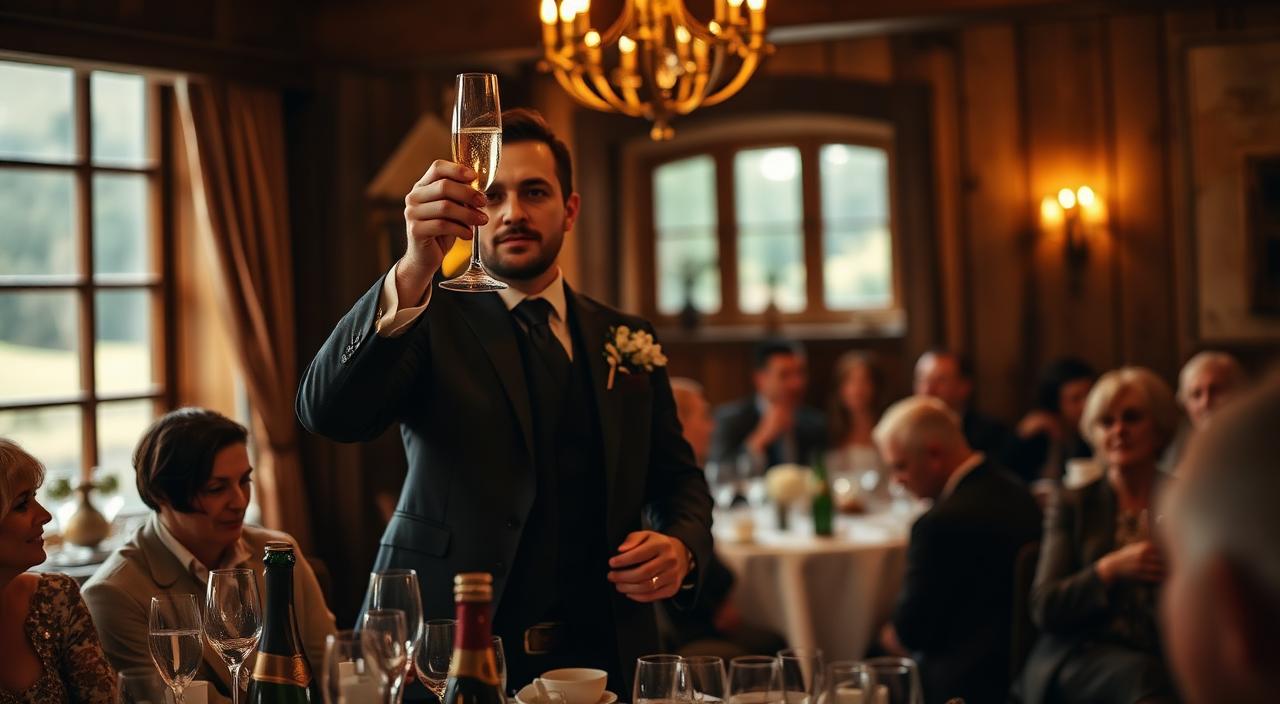
"So if you'd all please be upstanding, charge your glasses, and join me in raising a toast to the bride and groom. To Sarah and James."
Then a few practical notes:
- "Be upstanding" is the British phrasing. Americans say "please rise". Stick with the British version.
- "Charge your glasses" means top them up. The waiting staff should have done this a few minutes before the speeches. If they haven't, pause and let people pour. Don't toast a half-empty room.
- Raise your own glass at chest height, not over your head. Eyes on the couple, not the floor.
- Repeat the names slowly — "to Sarah, and James" — so the room can echo it back. They will.
- Wait for the echo. Stand still. Smile. Let it land. Then sit down.
Don't tag a joke onto the end of the toast. Don't say "cheers, big ears". The toast is the last beat. You earned it. Let it close cleanly.
When there's no father of the bride
Increasingly common, for all the obvious reasons. A few options the couple might choose:
- The bride's mum gives the opening speech. Same content, same toast.
- A stepfather, brother, uncle, or close family friend does it.
- The bride opens her own wedding. Brilliant when it works.
- No opening speech at all — the groom goes first.
Your job as best man doesn't change. Your toast is still the closer. But you might want to acknowledge the absent parent in a single warm sentence, if the family wants you to. Ask the couple. Don't freelance this. The wrong sentence about a missing dad is the kind of thing that gets remembered for the rest of someone's life.
Co-best man and best woman: how etiquette adapts
Two best men is now common. A best woman is now common. Mixed-gender bridal parties are common. The traditional etiquette didn't account for any of this, so people make it up.
A few patterns that actually work:
Two best men splitting the speech. One does the childhood stories, one does the more recent stuff. They alternate sections. Total length stays under eight minutes — not double. The toast is proposed once, by both, with one of them doing the wording.
Best woman alongside a best man. Same principle. Split the content by who knows what. She might cover the relationship side, he covers the lads side, or any combo that fits the friendship. The bride still gets toasted at the end.
Best woman alone. Same role, same toast, same expected length. The "reply on behalf of the bridesmaids" bit can be skipped or reframed — it's a tradition that doesn't really survive contact with modern weddings anyway.
Brother of the groom doubling as best man. Very common. Just different angle on the material — there's a separate guide on the brother of the groom speech if that's you.
The etiquette principle to hold onto: whoever stands up last proposes the final toast. That's the only bit that's load-bearing.
The drinks question: how drunk is the room?
Depends entirely on when the speeches are. This matters more than people think.
Speeches before the meal. The room is two drinks in. Sharp, attentive, hungry. Easiest crowd of the night. Lean into the funny bits — they'll land.
Speeches between starter and main. Three to four drinks in. Warm, generous, will laugh at most things. The classic UK slot.
Speeches after the meal, before dessert. Five to six drinks in. Loud, sentimental. The emotional lines hit harder. The complicated jokes don't.
Speeches after dessert with coffee. Seven plus. You're now the only thing standing between them and the band. Be short. Be warm. Land the toast and get off.
You don't get to choose this — the couple and venue do. But you do get to pace yourself. Don't drink heavily before your speech. One pint or a glass of wine is fine. Two is the limit. A best man slurring through his toast is the single most preventable disaster at a UK wedding.
After the speech? Drink whatever you like. You've done your job.
A quick word on traditional vs modern
People ask whether they should do the "traditional" UK best man speech or the "modern" one. The honest answer is: there isn't really a binary. There's a spine of etiquette — the toast, the order, the length, the register — and then there's everything else, which is yours.
Modern UK weddings have dropped the formality of the language but kept the structure. Nobody says "esteemed guests" anymore. Almost everyone still ends with "to the bride and groom". That balance — relaxed delivery, ceremonial close — is what works in 2026.
If your draft sounds like a Victorian dinner-party toast, modernise it. If it sounds like a podcast monologue, formalise the ending. Meet in the middle and you've got a UK best man speech that fits the room.
The honest sign-off
Etiquette guides like this one make it sound complicated. It isn't. Show up sober, keep the rings safe, speak for six minutes, propose the toast, sit down. That's the whole job.
If you want help with the writing bit — the part that actually keeps people awake at 2am — use Wingman to write it. Drop in the groom's name, a couple of stories, how you met, and you'll get a UK-tone draft in about a minute. You can edit anything you want and rehearse it from there. That's the difference between a speech that follows the UK best man speech rules and traditions and one that actually lands in the room. Good luck with it. You'll be fine.